ADVERTISEMENT
Three Baby Owls in One Nest: A Beautiful Glimpse Into the Secret Life of Owls
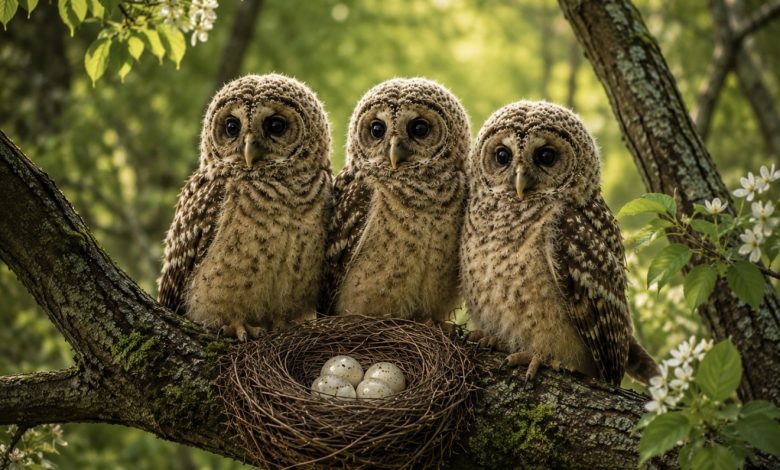
Seeing three young owls sitting quietly together beside their nest is a beautiful sight,
but there is much more happening in this scene than first meets the eye.
Young owls spend an important part of their early lives close to the nest, where they
depend on their parents for food, protection, and the skills they will eventually need
to survive on their own.
The First Weeks of an Owl’s Life
Baby owls, often called owlets, hatch from eggs after being carefully
incubated by their parents. When they are very young, they are vulnerable and depend
heavily on the adults.
As they grow, their soft down gradually gives way to stronger feathers. Their bodies
become more powerful, their eyesight develops, and they begin exploring the branches
around their nesting area.
This is one of the most fascinating stages of an owl’s life.
Why Do Young Owls Stay Together?
When several owlets hatch in the same nest, they may remain close to one another during
their early development.
ADVERTISEMENT
Sitting together can provide warmth and security while they wait for a parent to return
with food. Even after they become adventurous enough to move onto nearby branches,
young siblings may continue staying relatively close to their nesting area.
But this peaceful appearance hides an important reality: each young owl is preparing
for a future as an independent hunter.
Their Incredible Nighttime Abilities
Owls are famous for being remarkably effective hunters.
Their large, forward-facing eyes help them see extremely well in low-light conditions.
Their sensitive hearing can also help them locate small animals hidden beneath leaves,
vegetation, or darkness.
One of their most impressive adaptations is their quiet flight.
ADVERTISEMENT
Specialized feather structures help reduce the noise produced as an owl moves through
the air. This allows many owls to approach prey with extraordinary stealth.
What Do Owls Eat?
The exact diet varies depending on the owl species and its habitat.
Many owls hunt small mammals such as mice and voles, while others may eat insects,
small birds, reptiles, amphibians, or other available prey.
Because many species consume rodents, owls can play an important ecological role in
maintaining balance within their habitats.
When Do Young Owls Leave the Nest?
Young owls do not become expert flyers overnight.
ADVERTISEMENT
As they mature, they begin moving around the nest and nearby branches before developing
stronger flight abilities. Their parents may continue feeding and watching over them
during this transitional period.
Eventually, the young birds become increasingly independent and begin learning to hunt
for themselves.
That small owlet sitting quietly on a branch today could soon become a remarkably
capable nighttime predator.
A Reminder of the Beauty of Wildlife
A family of young owls offers a rare glimpse into a hidden part of nature.
Behind those enormous eyes and fluffy feathers are animals developing extraordinary
senses, learning how to fly, and preparing for independent life in the wild.
ADVERTISEMENT
The next time you hear an owl calling after sunset, remember that somewhere among the
trees, another generation may be beginning its own fascinating journey.